Aquator - How it works
The problem
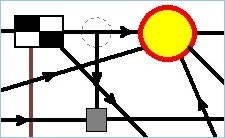
Simulation of complex, conjunctive use water resource systems is a difficult task
and is seldom straightforward. Ostensibly similar components such as river abstractions
and reservoirs are often operated in ways which are specific to each case.
Furthermore, there are often complex interrelationships between components. For
example, regulation releases may be triggered from a reservoir in response to hydrological
conditions, state of reservoirs elsewhere and possibly state of other potential
regulation sources.
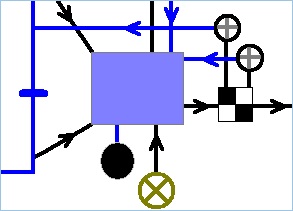
The decision-making process that determines, on a day-to-day basis, where water
will be abstracted to meet demand is not one purely based on cost optimisation and
link capacity. Other factors such as the state of a resource or state of an abstraction
licence are often equally, if not more, important.
Philosophy
Aquator enables you to construct a representation of your system
on-screen by dragging and dropping components from the toolbox onto the schematic
area.
Once you have constructed your schematic from the available components and entered
values for the parameters required by each component, you will have a fully working
model.

Each component encapsulates a set of operating rules. Aquator seeks
to satisfy the daily demand by automatically enforcing these rules no matter how
complex the system.
While obeying these rules Aquator executes Aqua solver.
This is a linear optimisation algorithm, which tries to find the best solution for
daily water movement by supplying at lowest cost when water is plentiful or supplying
according to the state of resources when water is scarce.
When you have custom rules specific to your organisation, or complex interrelationships
between components, you can use Microsoft® Visual Basic® for Applications (VBA) to modify
the built-in rules. This is the same tool as found in Microsoft Excel®. Many users
of Aquator are comfortable using VBA themselves, but should you
not wish to undertake customisation yourself you can employ the services of any
VBA programmers world-wide who are familiar with this industry standard programming
language.
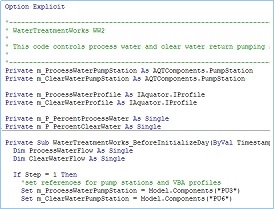
You can customise a model as little or as much as you wish, even entirely replacing
the operating rules built into each component. Even this does not exhaust the possibilities
provided by VBA. You can write VBA macros that perform non-operational tasks such
as global parameter modifications, analysis of results, custom data entry forms
and more. In this way you can extend Aquator to meet your requirements.
Aquator has an open software architecture and we actively encourage
and support third parties to add new components and features.
See the online manual for
more information.
|